About the Land
A land acknowledgement is not enough.
Beneath the concrete, there is a forest. Long before European colonizers arrived in what we now call New Orleans, these lands were called “bvlbancha”— the “land of many tongues”. For hundreds of years, the land formed by the flooding of the Mississippi River served as a seasonal home and trading hub for over 40 Indigenous tribal nations, including the Houma, Chahta, the Chitimacha, Tunica-Biloxi, Washa, Chawasha, Atakapa-Ishak, the Natchez and many more. Bvlbancha still exists today, and many of the tribal nations who first stewarded these lands continue to struggle and fight to protect this precious ecosystem from ongoing colonial threats— from land theft to coastal land loss, climate change to petrochemical pollution, from cultural erasure to ongoing genocide of Black and Indigenous peoples.
The land that we now call “Pigeon Town” (or “Pension Town”, “P-Town” or “Leonidas”) was settled and turned into a plantation where hundreds of enslaved Africans were forced to labor and endure untold brutality for the enrichment of a small handful of European plantation owners. The surrounding town of “Carrolton” was formed out of the Macarty Plantation, where enslaved people resisted their captivity and exploitation from the very beginning by frequently fleeing into the nearby swamps and marshes to form “maroon” communities— joining up with nearby Indigenous tribes to resist the imposition of colonialism and enslavement. This legacy is what birthed the “Mardi Gras Indians” (or “Black Masking Indians”) tradition.
The legacies and scars of settler-colonialism and racial capitalism continue to shape the land, the plants, the animals and the people who live here today. The legacies and lessons of resistance also continue to shape the struggle for collective liberation, right here and now.
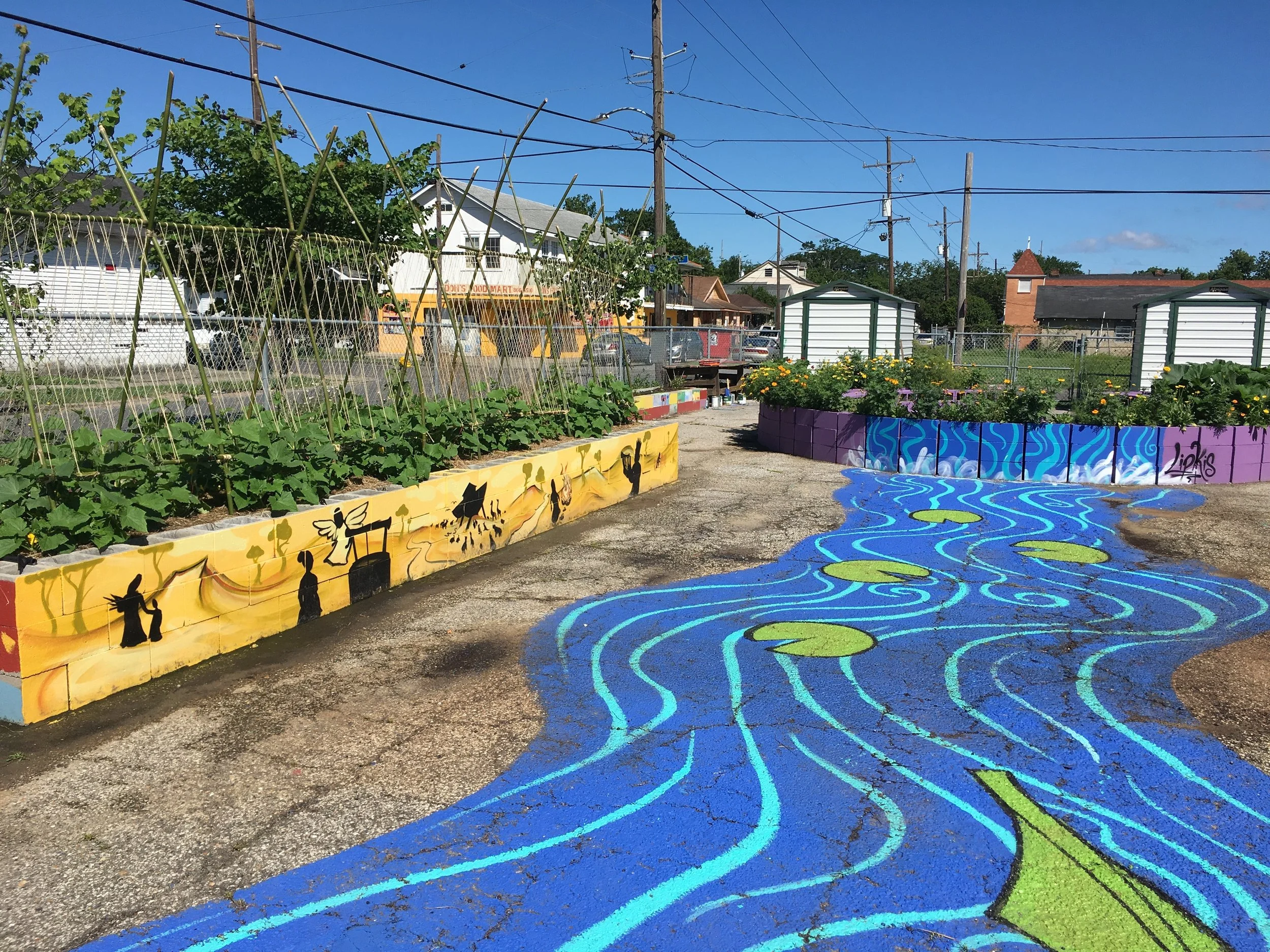
Okra Abbey sits on the former parking lot of the James Weldon Johnson Elementary School. Beneath the concrete, there is a forest. We remember.
Acknowledgement and awareness of the “past-as-present” is a necessary condition for our material and spiritual liberation. But without ongoing commitment and tangible action towards repair and transformation, acknowledgement and awareness is not enough.
We know the earth is a miracle. We know the people, the plants, the land— they are our kin, our relatives, and in order to reclaim our humanity we must work towards returning to right relationship.